2025 Yes or No Tarot Reading Guide: Accurate Interpretation & Practical Advice
Luna Reed
August 8, 2025
tarotyes or no tarot reading2025 yes or no tarot reading guide
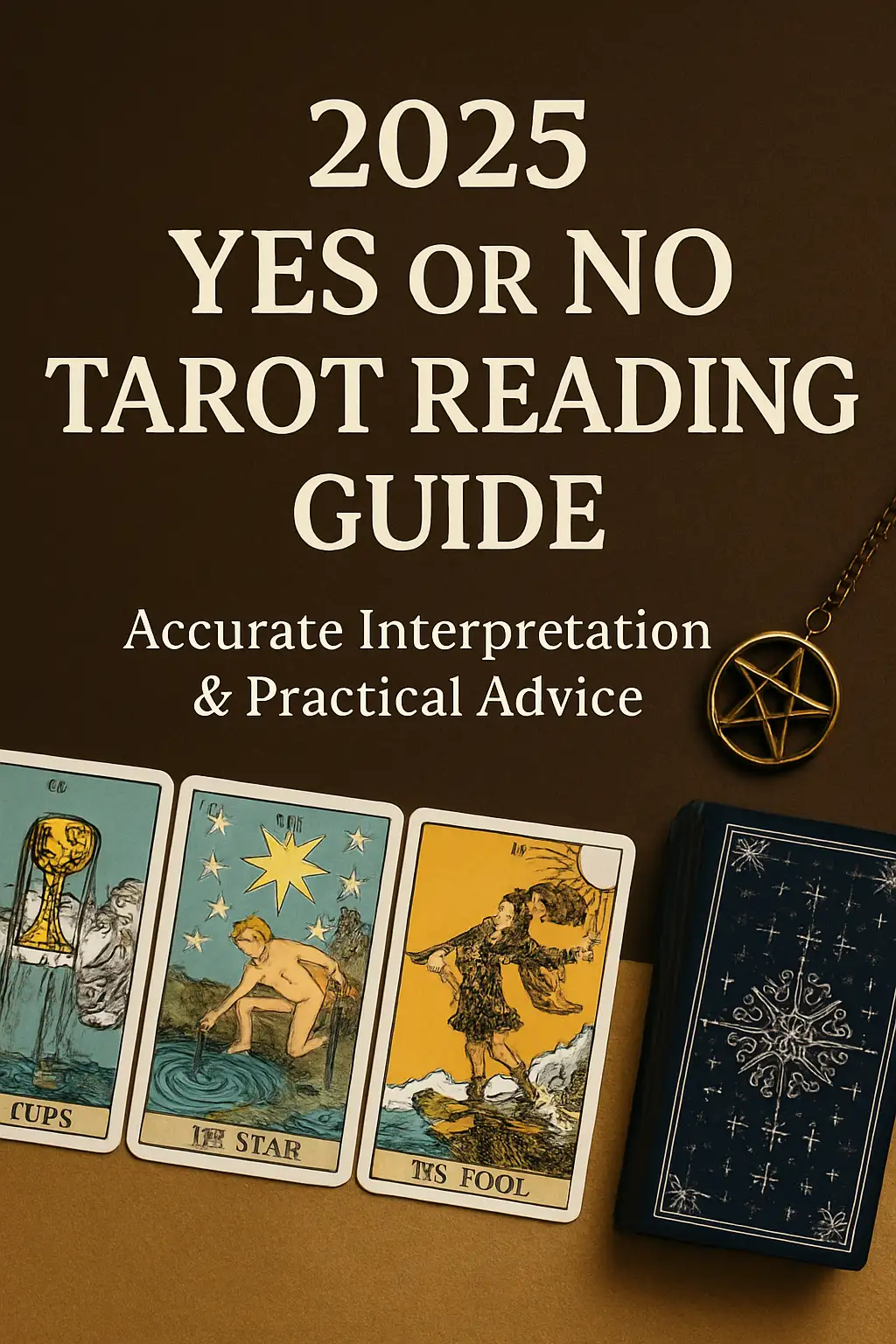
2025 Yes or No Tarot Reading Guide: Accurate Interpretation & Practical Advice
Yes or no tarot is the format most people encounter first, and it's also the one most likely to be used poorly. The appeal is obvious: you have a question, you want a direct answer, and a single card seems like it should be able to provide one. The problem is that "yes" and "no" require a level of certainty that tarot isn't well-positioned to offer — and pushing the cards toward binary answers often produces readings that feel satisfying in the moment but don't hold up.
That said, yes/no readings do have legitimate uses when you understand what they're actually measuring.
What a Yes or No Reading Actually Does
Rather than accessing some external truth about future events, a yes/no reading works as a prompt for your own intuitive response. When you pull a card and it registers as "yes" energy, what's often happening is that your subconscious has already made a decision and the card is helping you surface it. This is why the first gut reaction to the card often matters more than the official interpretation.
The mechanism matters. If you frame a reading as "the universe will tell me yes or no," you're outsourcing a decision. If you frame it as "I'm using this card to check where I actually am on this question," you're using it as a diagnostic tool. The second framing is much more useful.
The Basic System
The simplest yes/no approach: upright cards generally carry affirmative or forward-moving energy; reversed cards carry blocking or cautionary energy. Cards from the Major Arcana carry more weight than Minor Arcana in this context — a reversed Major Arcana card is a stronger "no" signal than a reversed Two of Cups.
The suit also matters. Wands and Cups tend to read more positively across the board — Wands bring action and forward motion, Cups bring emotional openness. Swords often carry complicating energy regardless of orientation; a "yes" from the Swords suit frequently comes with a caveat. Pentacles are usually pragmatic — they signal readiness when upright, caution or delay when reversed.
A few specific cards worth knowing for yes/no contexts: The Sun (upright) is the clearest positive signal in the deck. The World (upright) signals completion and success. The Tower is a strong warning regardless of orientation — not necessarily "no," but "not yet" or "not this way." The Moon signals confusion, which is itself an answer: the situation is too unclear to move forward right now.
Three Spread Options, Ranked by Usefulness
Single card. Works best for low-stakes daily questions: "Is today a good day to have a difficult conversation?" or "Should I send that email?" Keep the scope narrow. Don't use a single card for major life decisions.
Three-card yes/no spread. The first card represents the current situation, the second shows the tendency or direction of energy, the third offers a qualifier or context. Two cards pointing in one direction and one in another is more useful information than you'd get from a single draw — it shows you where the tension is.
Clarifier pull. When a single card feels genuinely ambiguous, pull one additional card and place it beside the first. Don't keep pulling cards looking for a different answer; one clarifier is the limit.
The Questions That Work and the Ones That Don't
For yes/no readings to be useful, the question needs to be specific and actionable. "Will I be happy?" doesn't work — happiness isn't a binary outcome and the timeline is undefined. "Should I accept this job offer?" is workable because there's a concrete decision attached.
Questions about other people's internal states don't work either. "Does he want to get back together?" is asking the cards to read someone else's mind. Reframe it: "Is reconnecting with this person aligned with where I'm trying to go?" Now it's about your situation, not theirs.
Questions you've already asked multiple times this week should not be asked again. Emotional urgency isn't the same as genuine uncertainty, and repeated readings on the same topic tend to generate noise rather than signal. If you've already pulled cards on a question and didn't like the answer, sit with it for at least a few days before returning.
AI Tarot Tools in 2025
AI-generated tarot interpretations have become widely available, and they're genuinely useful for one specific purpose: getting quick, consistent explanations of card meanings when you're learning. For that use case, they work well. The limitation is that AI readings lack the contextual flexibility of working with a specific question in a specific moment — and the emotional resonance of the reading, which is a significant part of what makes it useful, doesn't fully translate to a generated interpretation.
I'd treat AI tarot tools the way I'd treat any reference: useful for learning the vocabulary, not a substitute for the actual practice.
Common Mistakes
Asking the same question repeatedly is the most common issue. The second is treating the reading as a decision rather than information. If you pull The Tower on a question about whether to start a business, that's worth thinking about seriously — but it doesn't mean "don't do it." It might mean the current approach carries significant risk, or that your timing needs adjustment. Nuance matters even in a yes/no format.
The third mistake is using yes/no readings for questions that are actually complex. If a situation involves multiple people, significant uncertainty, and consequences that span months or years, a simple yes/no draw isn't the right tool. Use a more structured spread, or use tarot as one input among several rather than the deciding factor.
When you get contradictory or genuinely unclear answers, the most useful interpretation is often that the situation itself is unclear or in flux. That's real information. It means conditions haven't stabilized enough for a clear read, and the practical response is to wait rather than keep asking.
🌙
About the Author
Luna Reed
Luna has been using tarot as a personal reflection tool since 2016. With a background in psychology, she approaches the cards not as a system of prophecy but as a structured framework for self-inquiry. She is skeptical of fortune-telling claims and more interested in what tarot reveals about the assumptions and patterns we bring to our own decisions.