How to Use Tarot for Daily Guidance: 7 Simple Spreads for Everyday Questions That Inspire Clarity and Calm
Luna Reed
October 26, 2025
tarotdaily tarotdaily guidanceeveryday questionssimple spreads
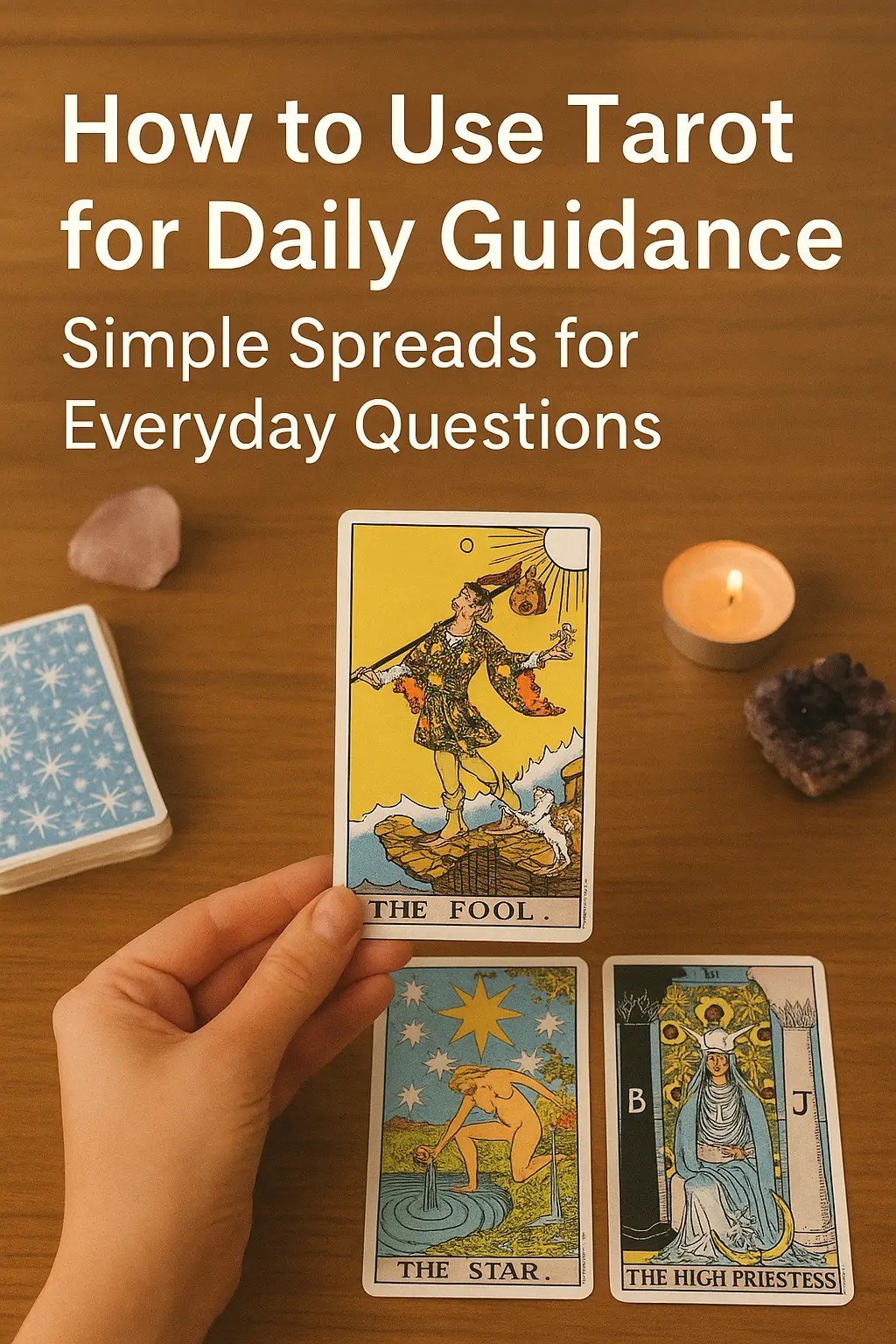
How to Use Tarot for Daily Guidance: 7 Simple Spreads for Everyday Questions That Inspire Clarity and Calm
The most sustainable tarot practice I've encountered — and the one that has stuck with me longest — is also the simplest: one card, in the morning, with a single focused question. Not because elaborate spreads lack value, but because daily practice builds the interpretive muscle that makes those larger readings meaningful.
Daily tarot isn't about predicting what will happen. It's about entering the day with a defined point of attention. You pull a card, you hold a question, and then you go about your life noticing whether the card's theme shows up. Over time, this creates an unusual kind of self-knowledge — a vocabulary for the patterns in your days that's hard to develop any other way.
Why a Daily Practice Works Differently Than Occasional Readings
Occasional readings tend to be event-driven: something significant is happening, you want insight. That's a perfectly valid use of tarot. But daily practice builds something different, which is familiarity. When you've drawn the Eight of Swords fifteen times and tracked what was happening in your life each time, you have a richer relationship with that card than any guidebook can give you.
In my experience, the people who find tarot genuinely useful over the long term almost always have some kind of regular practice. The ones who dip in only during crises often find it frustrating, because they haven't built the interpretive context to work with the cards fluidly.
The daily draw also functions as a check-in. Before pulling the card, you have to pause, clear the deck, formulate a question. That 60-second pause is not trivial. It creates a small moment of intentionality before the day starts moving.
The Spreads
These are the layouts I'd actually recommend for daily use — ordered from simplest to most structured.
Single card. The core practice. Ask "What's worth paying attention to today?" or "What energy will be useful to work with?" — something that doesn't require a binary answer. The card becomes your theme or lens for the day.
Two-card contrast. One card for what to lean into, one for what to watch out for. This works well on days when you're entering a complex situation and want a sense of the dual energies at play. Keep the positions clearly defined before you pull.
Three-card daily flow. Morning energy, afternoon shift, evening resolution. This is less predictive than it sounds — it's more about tracking how your internal state tends to move through the day. Over a few weeks, you'll notice whether you're consistently pulling heavy cards in the middle position, which might indicate something worth looking at.
Mind-body-spirit check. Three cards covering your mental state, physical energy, and what's moving underneath the surface. I find this most useful on mornings when I feel off but can't quite identify why. The cards often name something I was vaguely sensing.
Question-obstacle-resource. What's the core question I'm carrying today? What's in the way? What do I already have that's useful? This is a structurally different spread because it's not about the day's external events — it's about your internal relationship to a specific challenge.
Yesterday's reflection. A single card drawn in the evening and asked: "What did today most need me to see?" I use this as a journaling prompt rather than a predictive tool. It works surprisingly well for processing a difficult or confusing day.
Weekly anchor. One card pulled on Monday, held through the week. Ask "What's the theme this week is inviting me to work with?" Review it on Friday. This is a slower practice that's useful when daily drawing feels like too much — it gives you something to observe without requiring daily engagement.
Keeping It Grounded
A few things that make the difference between a practice that sustains and one that fades:
Write it down. Even a single sentence — "Drew the Five of Cups, feeling like there's something I'm missing" — creates a record you can revisit. After a month, reading back through your notes will show you patterns that weren't visible day-to-day.
Don't over-interpret. Some days a card just doesn't land clearly. That's fine. You don't need a profound insight every morning. The value of the practice comes from consistency, not from every single reading being meaningful.
Avoid multiple pulls on the same question. If a card doesn't resonate, note your resistance and move on. Pulling more cards in search of a different answer is how the practice loses its usefulness — it becomes about comfort-seeking rather than genuine reflection.
Reversals are optional. If you're doing daily draws, I'd suggest working with upright-only for at least the first few months. Reversals add a layer of nuance that can be genuinely useful, but not before you've built a comfortable relationship with the upright meanings.
How to Integrate It with Journaling
Tarot works particularly well as a journaling prompt. Pull a card, write for five minutes about what it brings up — not necessarily about the card's meaning, but about what feels relevant in your own life. The card gives you a starting point that bypasses the blank-page problem.
Over time, this creates a kind of indexed record: you can search your journal for every time you drew The Hermit, or every time you drew something in the Pentacles suit during a month when you were thinking about money. The patterns that emerge from that retrospective are usually more useful than any single reading.
The combination of daily draws and journaling is probably the highest-value entry point for anyone who wants tarot to be more than a novelty.
🌙
About the Author
Luna Reed
Luna has been using tarot as a personal reflection tool since 2016. With a background in psychology, she approaches the cards not as a system of prophecy but as a structured framework for self-inquiry. She is skeptical of fortune-telling claims and more interested in what tarot reveals about the assumptions and patterns we bring to our own decisions.