Tarot Card Spreads & Future Predictions for 2025: A Complete Guide
Luna Reed
July 12, 2025
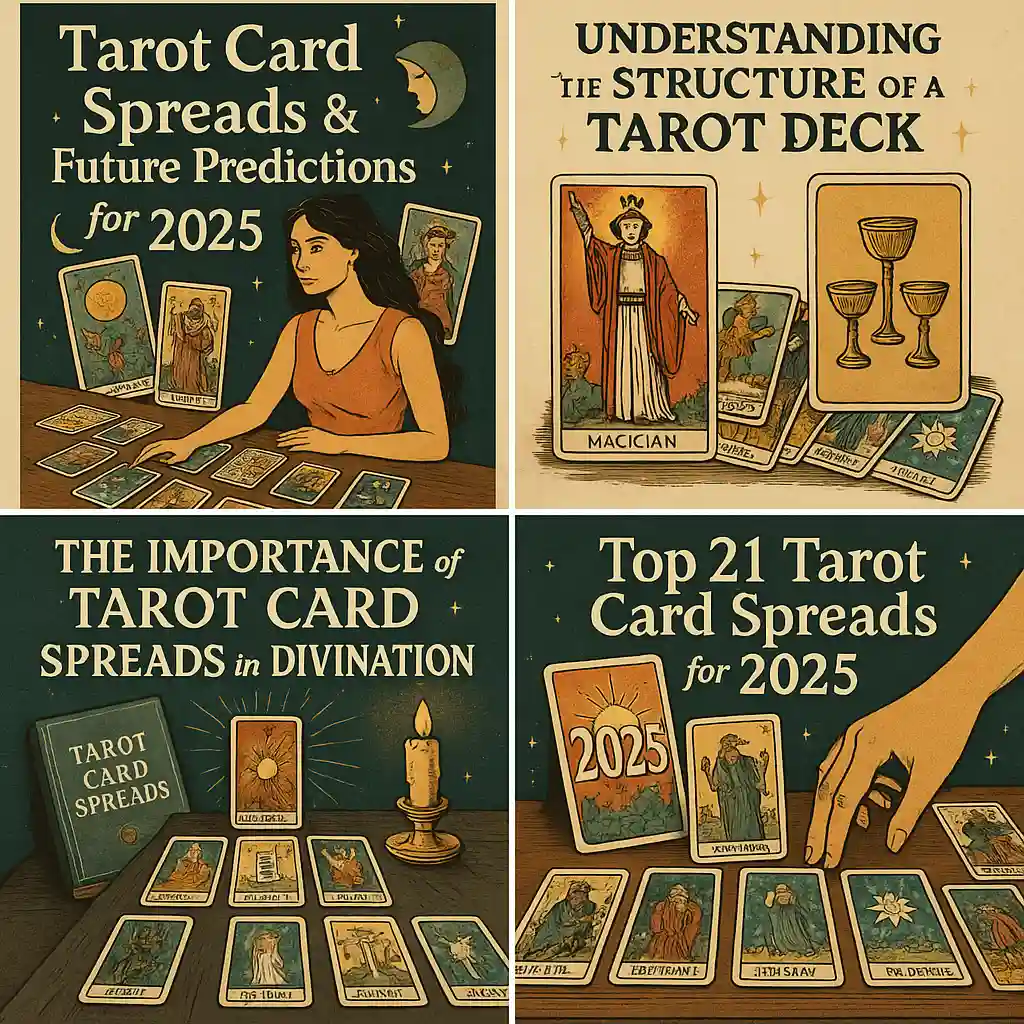
Tarot Card Spreads & Future Predictions for 2025: A Complete Guide
Tarot has been used as a tool for self-examination for centuries. The specifics shift — the imagery evolves, the access methods change — but the underlying function stays consistent: a structured system of symbols that prompts reflection on questions that don't have easy answers.
I want to address the "predicting the future" framing directly, because it shapes how people approach readings. Tarot doesn't reveal fixed events. What it does is surface the energies, patterns, and tendencies that are present right now — which then influence what's likely to happen if nothing changes. That's a meaningful distinction. It means readings are most useful when treated as input to your own judgment, not as authoritative announcements.
The Deck as a System
A standard 78-card deck divides into two main groups. The Major Arcana's 22 cards represent larger forces and life themes — the kinds of experiences that feel significant and formative. These aren't everyday occurrences; they're the turning points, the crises, the moments of genuine transformation. Cards like Death (change, transition), The Tower (sudden disruption), and The World (completion, integration) belong here.
The Minor Arcana's 56 cards cover the texture of daily life across four suits. Cups handle emotional experience and relational dynamics. Wands cover energy, motivation, and creative drive. Swords deal with thought, conflict, and the difficulties that come from how we think and communicate. Pentacles address material reality — work, money, physical health, practical concerns. Each suit runs from Ace (pure potential) through Ten (completion), with four court cards representing personality types or roles.
The interaction between Major and Minor cards in a spread creates the reading's texture: Major cards show the larger forces at work, Minor cards show how they're playing out in ordinary life.
Spreads for Different Types of Questions
The right spread depends on what you're actually trying to understand. Using the Celtic Cross for a simple daily question is overengineering; using a single card for a complex life decision doesn't give you enough to work with.
For daily or weekly guidance, the single-card draw remains the most practical. It's a focal point, not a prediction. Ask something open-ended: "What deserves my attention this week?" or "What's the quality of energy I'm working with right now?" Then observe whether the card's theme shows up in your actual experience.
For specific decisions — a career change, a move, a significant relationship choice — a five to seven card spread gives you more to work with. A format I find useful: the situation as it currently stands, what you're not seeing clearly, what you actually want underneath the stated goal, the likely outcome if you stay on the current path, and what would shift if you changed approach. This structure forces you to articulate the question more precisely, which is itself useful.
For relationship questions, the mirror spread is worth knowing: two parallel cards representing each person's perspective, a central card showing the dynamic between them, and a final card indicating what needs to change or be acknowledged. This works for romantic relationships, professional conflicts, and family tensions.
For annual or longer-term planning, a twelve-card spread with one card per month gives you a framework — not a prediction, but a set of themes to hold loosely as the year moves forward. What I've found is that these year-ahead readings are most accurate in their identification of recurring themes rather than specific events. You might pull The Hermit for March and find yourself in a period of unexpected isolation, or you might simply find that March requires more internal work than external output.
Interpreting Spreads: What the Position Does
In a multi-card spread, the position matters as much as the card. The same card means something different in a "challenge" position than in an "opportunity" position. Before pulling cards, it's worth being precise about what each position is meant to reveal.
When cards in adjacent positions seem contradictory, that's usually meaningful rather than a mistake. A hopeful card in the "what you want" position alongside a challenging card in the "what's blocking you" position tells a coherent story. Read the spread as a narrative rather than as isolated data points.
Court cards — the Pages, Knights, Queens, and Kings — can represent people in your life, aspects of your own personality, or the kind of energy a situation requires. Context determines which interpretation fits. I tend to read them as personality energies first and as actual people second, because that keeps the reading focused on your own agency rather than speculation about others.
Working with Challenging Cards
The cards people most often fear are usually the ones worth examining most closely. The Tower, which shows up frequently in readings about situations under stress, represents rapid disruption — but disruption usually means something that needed to change is finally changing. It's not comfortable, but The Tower rarely appears when everything is genuinely fine.
Death is almost never about literal endings. It's about transformation — the kind that requires something to be fully released before something new can take its place. The cards in surrounding positions usually clarify what's being released and what's emerging.
The Moon signals illusion, confusion, or something that's not yet clear. Rather than forcing an interpretation, treat it as a reminder to gather more information or wait for the fog to clear before acting.
Astrology, Numerology, and Combining Systems
Tarot has natural connections to both astrology and numerology that practitioners use to deepen interpretations. Each Major Arcana card corresponds to a planetary or zodiac influence — The Moon card connects to lunar energy, The Hierophant to Taurus, and so on. If you're familiar with your own astrological chart, these correspondences can add texture to how you read certain cards.
Numerologically, the year 2025 adds to 9 (2+0+2+5), which in most systems represents completion, reflection, and clearing out before a new cycle begins. If you're doing an annual planning spread, that theme is worth holding alongside whatever individual cards you draw.
These additional systems are optional. If they're useful to you, incorporate them. If they add complexity without adding insight, leave them aside. Tarot works without supplementary systems; they're tools for people who already find those frameworks meaningful.
On Digital and AI Tarot Tools
Online and app-based tarot tools have made practice accessible in genuinely useful ways, particularly for people learning the cards. Getting a consistent explanation of the Three of Pentacles at 11pm when no books are nearby is legitimately helpful. The limitation is that generated interpretations don't adapt to the specific texture of a question the way a careful human reader can.
I'd treat digital tools as reference material rather than as the reading itself. They're good for learning card meanings, for getting unstuck when an interpretation isn't landing, and for practice when you don't have your physical deck. The actual interpretive work — sitting with a question, noticing your reaction to the imagery, connecting the cards to your current reality — still happens inside you.
🌙
About the Author
Luna Reed
Luna has been using tarot as a personal reflection tool since 2016. With a background in psychology, she approaches the cards not as a system of prophecy but as a structured framework for self-inquiry. She is skeptical of fortune-telling claims and more interested in what tarot reveals about the assumptions and patterns we bring to our own decisions.